
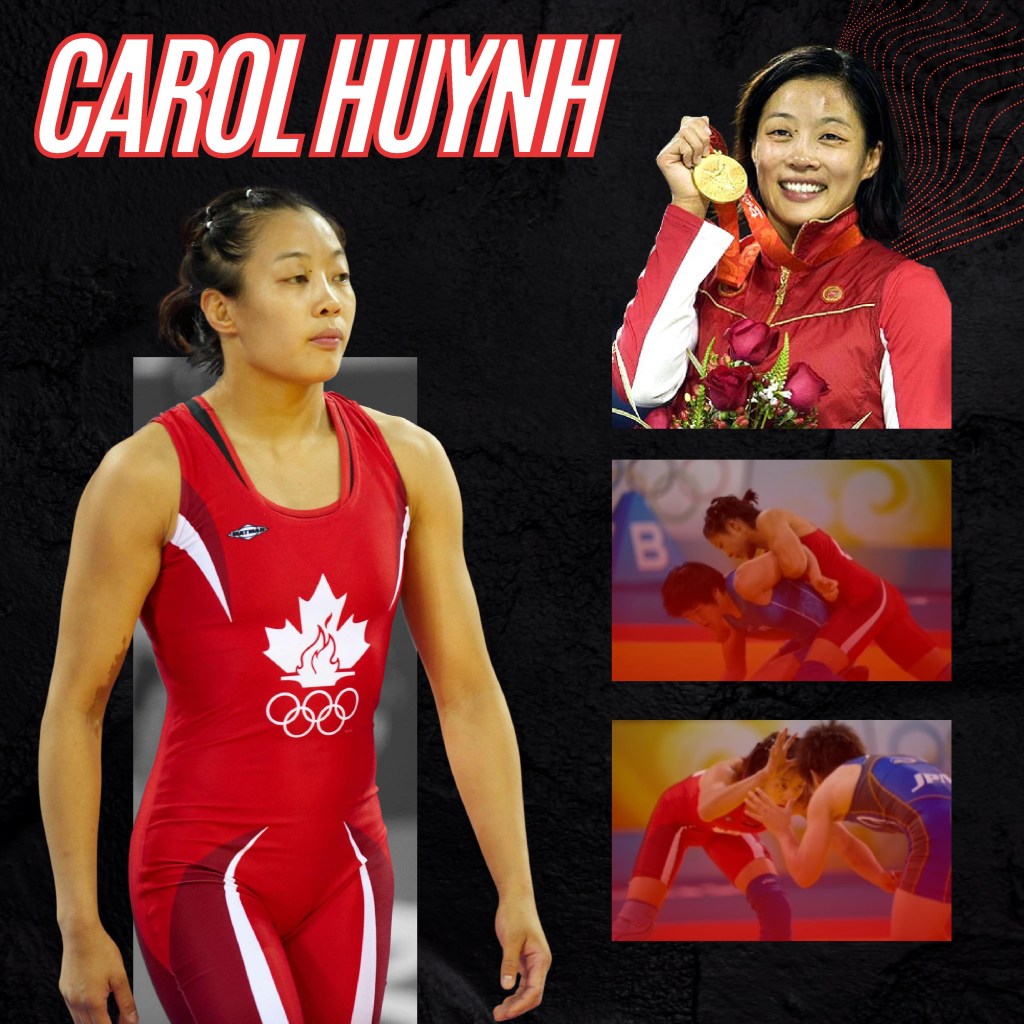

The Olympic gold medalist lost, and then found herself in the sport of wrestling
Carol Huynh looked surprisingly calm for someone who had just won an Olympic gold medal. The Canadian wrestler was wearing her country’s signature red and white as she stood on the floor of the China Agricultural University Gymnasium, home to the 2008 Beijing Olympics’ wrestling events.
Her eyes glanced around the stadium as she waited, transfixed in front of the yellow podium that she was soon to climb. To her left were the bronze medal winners from Azerbaijan and Ukraine, both sporting blue tracksuits. To her right stood Chiharu Icho, the Japanese wrestler who she had just beaten in the gold medal bout.
When her name was called, Huynh took two steps to ascend to the podium’s top spot where she was met by a roar of applause from the crowd packed into the stands. After the gold medal was draped around her neck by a suit-clad official, the Canadian flag started climbing towards the roof and the opening tones of the national anthem began to play, giving way to tears from Huynh, who had just become the first Canadian woman to win wrestling gold at the Olympics.
Two-and-a-half years later, Huynh watched Alexandre Bilodeau prepare to step onto a historic podium of his own. The 23-year-old Quebec native had skied his way to the first Canadian gold medal on home soil at the 2010 Winter Olympics in Vancouver.
Huynh was there, but not as a participant this time. She and a few other Olympians were tasked with meeting groups of fans who had flown in from Calgary at the airport and escorting them to the hotels they were staying at.
After Bilodeau took the podium, some of the fans in the group she was with started to speculate, with some figuring he’d make a million dollars after the Games. Huynh had a hard time coming to terms with the fans’ perception of how an Olympian should be valued. “It doesn’t work like that,” she remembers thinking.
Thoughts questioning why she wasn’t a millionaire, why her performance or her sport weren’t valued higher had become common for Huynh, and the fans’ comments only exacerbated those feelings. This wasn’t the first time she had fought with the concept of her own worth since she stood atop the podium in Beijing, but it was the first time that she recognized something needed to change. In response, Huynh set about on a mission to rediscover her connection with the sport she fell in love with as a teenager.
Elite athletes who experience mental health struggles are often abandoned by the system they dedicate their lives to. After reaching the pinnacle of the sports world by winning Olympic gold, Huynh didn’t know what would come next. In the four years between the 2008 and 2012 Olympics, her relationships with her medal, her sport and her mind were all tested.
According to a 2021 study published in the British Journal of Sports Medicine, struggling with mental health after the Olympics is quite common in athletes as 24 per cent of those surveyed reported high or very high levels of psychological distress.
Huynh grew up in New Hazelton, B.C., a remote Northern community of less than five thousand. She was the first of her family to be born in Canada after her parents and older sister immigrated to New Hazelton from Vietnam.
With a father who worked 12 hour shifts at the local sawmill and a mother who encouraged her children to be active, Huynh and her siblings had the freedom to experiment with a number of sports growing up. They’d go to the local cul-de-sac and shoot around on the neighbours’ basketball net until it was too late in the day to see the ball or too late in the year to feel their fingertips. There was also the ‘Green Rink’, where the kids of New Hazelton would play hockey or ‘Macgyver’ ramps to ride their bikes on.
In many of these adventures, Huynh found herself tagging along with her strong-willed older sister, Ngoc. It was only natural that when her sister started wrestling, Huynh decided that she would follow suit. In a small body with a shy personality to match, she mustered up the courage to show up to a wrestling team practice—in New Hazelton, there were no tryouts and therefore no cuts—in grade nine. Her sister had graduated high school months prior, and Huynh’s first grade nine wrestling practice quickly became her only one of the season.
The following year, a big group of Huynh’s friends wanted to wrestle. So when she was in grade ten, they all showed up for practice, reporting to the high school’s insulation-coated basement. Huynh admits that it wasn’t a great space, but the wrestling mat tucked into the bottom floor with the janitor’s storage room quickly became her home away from home. All of a sudden, her personality outgrew her body.
“I definitely think [wrestling] contributed to me feeling more comfortable in my own skin,” says Huynh. “I wasn’t just this small, meek Asian girl. I could be strong.”
After falling in love with wrestling in grade ten, Huynh held onto it and never let go. She wrestled at Simon Fraser University during her pursuit of an undergraduate degree, all while competing in international competitions. She established herself as a force to be reckoned with in the early 2000s after reaching the podium in back-to-back World Wrestling Championships.
Some time after the 2004 Olympics, Huynh started working with long-time acquaintance Paul Ragusa at the University of Calgary. Ragusa, a former Olympian himself, proved to be an invaluable training partner. He had the uncanny ability as a coach to study her upcoming opponents and emulate their habits, strengths and weaknesses on the mat in order to best prepare Huynh for bouts.
Huynh had encountered Icho across a decade of competitions and had never once gotten the better of her. Ragusa remembers emulating the Japanese wrestler ahead of the 2008 Beijing Olympics gold medal bout countless times so that wrestling Icho would feel like second nature to Huynh.
On the day of the competition, Ragusa got to the gym ahead of Huynh. It started getting closer to her bout and still there was no sign of Canada’s representative. He remembers her arriving at the last minute, late because she forgot her wrestling boots. Most would expect Huynh to be shaken, showing up late to a gold medal bout against a formidable opponent in her first Olympics. Ragusa, who was worried internally while attempting to maintain a calm front, saw the opposite.
“She just had this calm about her,” he recalls. “I knew she was ready.”
He remembers seeing her gently fold up her clothes as if in no rush before she walked out to the mat. After a frantic three minutes and fifty seconds of grappling and tussling, Huynh flung her arms to the roof in a show of unadulterated delight as she became the first Canadian female wrestler to win Olympic gold.
“I never got into the sport of wrestling to be famous or to make money,” says Huynh. “I loved it because I felt strong. I felt confident.”
Huynh knew that the win was historic, but she didn’t quite grasp the significance of her feat. At least, not until after the Closing Ceremony, when Huynh was in Thailand on vacation with her husband. She remembers receiving countless Facebook messages from family, friends and fans alike. The resounding congratulations were nice, but there were messages that contained more than just that. So unused to seeing an Asian-Canadian athlete at the pinnacle of the sports world, people across the nation were reaching out to Huynh to express their admiration for her.
In the months following, the press was keen to speak to Huynh about her gold medal. Newly aware that she was a role model to Asian and female athletes throughout Canada, she was determined to uphold a certain prestige in the media. She felt a responsibility to be a figurehead of sorts to the people who looked up to her.
After her exchange with the group of fans at the Vancouver Olympics in 2010, she decided to make a change. She felt like she had been punishing herself, and it needed to stop.
“I never got into the sport of wrestling to be famous or to make money,” says Huynh. “I loved it because I felt strong. I felt confident.”
The process wasn’t easy nor fast, and she didn’t do it alone. But, with the help of her husband, friends and coaches, Huynh got to a place where she felt comfortable wrestling again. After much contemplation, she came back from a string of injuries to compete in the 2012 London Olympics.
Huynh used to return to her high school in New Hazelton every year after winning gold in 2008. She’d talk to the students about her journey in a bid to inspire them. After all, she was living proof that people from their tiny town could be anything. One year, she got more candid in her speech than she had ever been before. She talked about struggling with her sense of self-worth after the Beijing Olympics. Huynh still doesn’t know how her message resonated with the students, but she’s glad she voiced it.
“I believe that the reality of struggle and triumph is more impactful than the illusion of everything going according to plan.”
Struggle she did, but in the end it was Huynh’s love for wrestling that triumphed as she returned to the sport to win bronze in London.
 Unique Togetherness
Leave a comment